Finding the Oldest Risks in Your Server Room
Perhaps, one of the most dangerous mantras in the server room is “If it ain’t broke, don’t fix it “. This usually refers to systems that still function and seem unsafe to make changes. Most of the time, this is an old system that supports something of critical importance. Unfortunately, this system may have already been patched many times over, and now, no one fully understands it anymore. This is what professionals in managed IT support services call a legacy debt. This is not simply an old technology, but rather, a technology that has come to be a dependency over time.
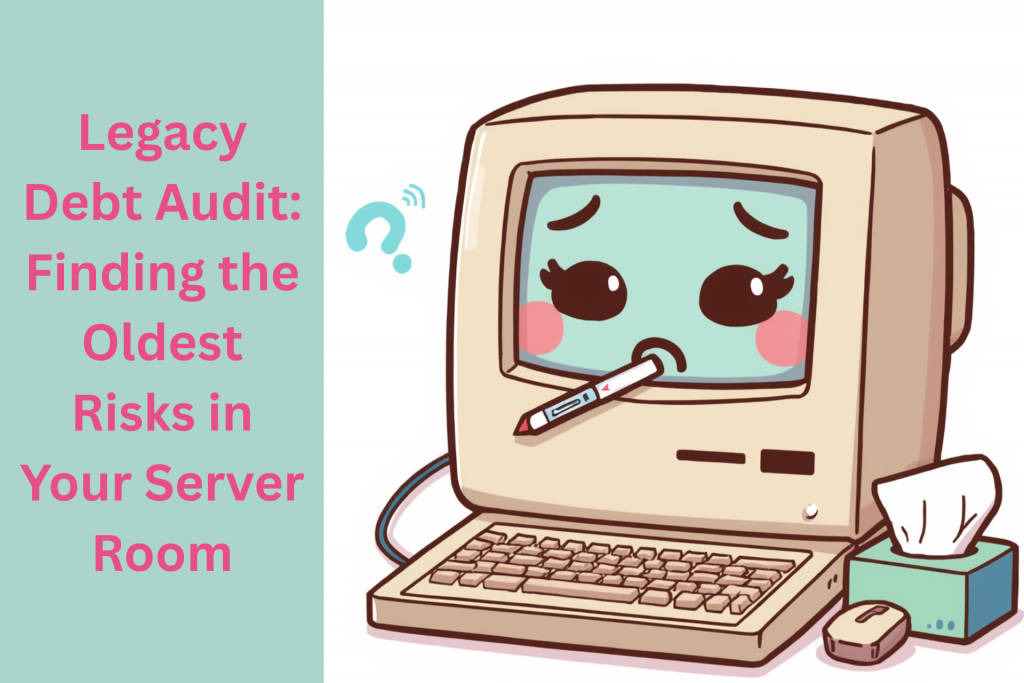
Legacy Debt Audit: An Important Part of Managed IT Support Services
Unfortunately, such systems silently build up risk. That usually ends up causing downtime, security exposure, or on-the-fly upgrades.
Managed IT Support Services Expert Breakdown What Legacy Debt Really Means
As mentioned earlier, old equipment that is not in use is not a legacy debt. What it is, though, is an old system that has become a part of everyday business and has no longer become a subject of doubt. Oftentimes, these are critical servers, forgotten edge devices, and temporary solutions that evolved into permanent solutions over a period of time. This debt grows silently and adds cost, limits flexibility, and increases risk without immediate visibility.
What makes this an issue is when the system becomes un-updateable. This usually happens when the system’s customer support is withdrawn thereby leaving it unpatched and vulnerable. Managed IT services support provider further explains that legacy debt also appears when basic maintenance declines. This means that although the system may still run, patching becomes inconsistent; monitoring weakens, and backups are no longer tested properly. In the long run, this makes a small problem a big operational and security challenge.
Where to Focus Your Audit First
Managed IT services support provider explains that not everything in the legacy risks has the same impact. While other parts of the system can be updated at a later time, certain parts are more critical due to the position or role they hold within the environment. Such high-risk locations are typically at the network edge, unsupported by the vendor, or have fallen out of compliance with a secure operating environment. Having a focused audit helps bring these risks into view. Rather than attempting to make everything right simultaneously, it places emphasis on the systems that are the most important. Thus, enabling the teams to gain control and minimize exposure systematically.
Risk One: Unsupported Edge Devices
The most at-risk systems can be located at the network edge. These consist of firewalls, routers, and VPN gateways that bridge your environment to the internet. Oftentimes, these systems are subject to attacks because they are the most exposed to traffic. When the security updates from these systems stop because of the discontinuation of support, these systems become more difficult to defend. Therefore, all edge devices must be identified, their support status verified, and those that are internet-facing highlighted. Furthermore, devices that are incapable of executing the current firmware should be flagged immediately. The replacement or upgrading of them should be seen as a priority since these high-impact risk systems can be gateways to potential attacks.
Risk Two: Systems That Cannot Be Patched
Outdated systems pose long-term risk when their updates are no longer made. Although they can run without any problem, every additional vulnerability becomes permanent. This makes the system become more dangerous as time goes by. Moreover, unsupported systems do not have a complete workaround. Hence, despite having temporary controls that can minimize exposure, they cannot completely remove risk. So, the only reliable solution is replacement or migration to supported platforms. In an audit, these unsupported systems must be identified especially when they have obsolete protocols or ineffective authentication. They usually include operating systems, applications, and specialized appliances.
Risk Three: Servers with Weak Maintenance Practices
Providers of managed IT support services, warn that there are some less evident risks as systems look healthy. For example, servers can still operate normally, but the maintenance practices in the background are already weak. This comes from patching being irregular, irrelevant services that are left on or active, and backups that no longer have routine tests. Such problems decrease the resilience of systems and increase the likelihood of failure in case of an incident. Because of this, an audit should review patch levels, service usage, access control, and backup reliability. In the same vein, the change management must also be analyzed so that accountability is ensured. Having strong maintenance practices prevents small issues from becoming major outages.
Turning Silent Risk into Action
Legacy debt does not announce itself clearly but rather silently and gradually grows in the background. However, it becomes a significant problem that leads to unanticipated downtime, security exposure, or emergency upgrades. Having a legacy debt audit restores visibility and control and brings undefined risks into the forefront so that teams can address them. By having a planned method of minimizing risk and enhancing stability, you can strengthen your system.
Do you need help figuring this out? Talk to one of our IT and cybersecurity experts today.
Call us now!
Tech Insights From EB Solution
Watch Our Latest Tech Videos From EB Solution

Get A Free Immediate Quote For IT Services
From EB Solution Today.
Why choose EB Solution:
- Around-the-clock IT services
- Expert technology professionals
- Single source for all your IT
- Reliable data backup solutions
- Certified cybersecurity experts
Ready to make the move to EB Solution?
Fill out the form to the right to get your free immediate quote.